
AUTS2 syndrome occurs when there is a change (variant) in one copy of the AUTS2 gene on chromosome 7. This gene plays an important role in brain development.
Key characteristics
AUTS2 syndrome affects each person differently, even among individuals with the same genetic variant. Development typically progresses steadily, though at a slower pace.
Many individuals affected with AUTS2 syndrome are described as social, affectionate and engaging.
Common features include:
Developmental delay, especially in motor and speech skills
Intellectual disability
Language delay
Differences in muscle tone (low or high muscle tone)
Feeding difficulties
Learning challenges
Attention challenges including ADHD
Autistic features
Short stature
Microcephaly
Some individuals may also experience:
Seizures
Heart conditions
Certain shared physical traits may be present, such as arched eyebrows, widely spaced eyes, droopy eyelids, a small mouth or a small lower jaw.
We are building a global AUTS2 community that accelerates research, supports drug development and turns scientific discovery into meaningful results for individuals and families.
Frequently Asked Questions
An AUTS2 diagnosis usually raises many questions. We’ve answered some of the most common ones below.
Have a question and don’t see it here? Send us a note!
-
AUTS2 was first identified in 2002, when a chromosomal disruption was found in a pair of identical twins with autism. Later work, including a 2013 study (Beunders et al., 2013), helped establish AUTS2 as a distinct genetic condition by identifying additional individuals and defining a consistent clinical pattern
Today, many hundreds of individuals with AUTS2-related changes have been identified worldwide, and that number continues to grow as genetic testing becomes more common.
AUTS2 syndrome is considered rare, meaning they affect fewer than 200,000 people in the United States. Nevertheless, some data support prevalence estimates approaching that for Phelan McDermid Syndrome, among the most common genetically defined forms of autism. In this context, researchers believe that therapeutics developed for individuals with autism-related syndromes may be relevant to autism more broadly.
Importantly, not all AUTS2-related conditions are the same. Different types of genetic changes can lead to different outcomes, and emerging research suggests that these differences may require distinct therapeutic approaches.
-
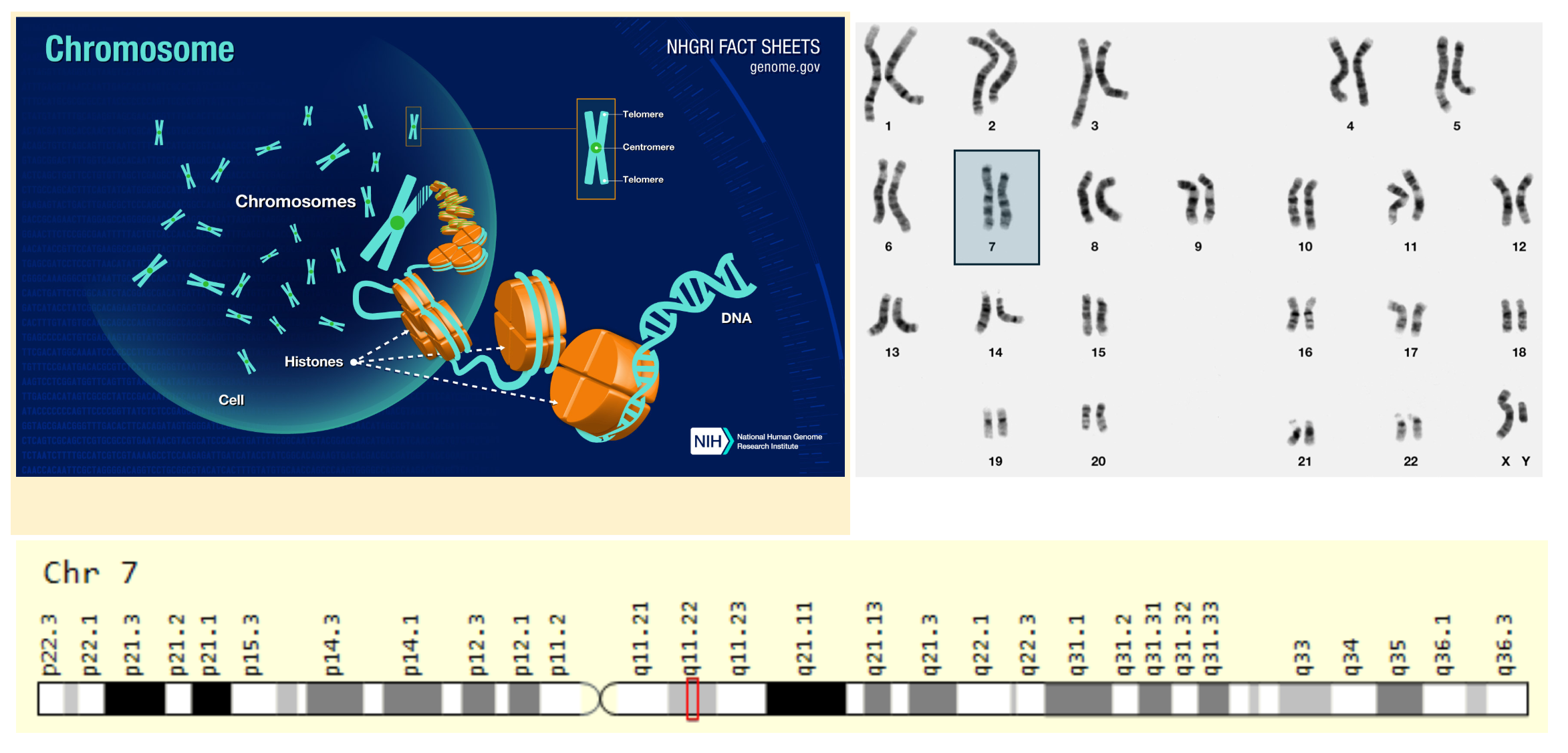
The AUTS2 gene is located on chromosome 7, in a region called 7q11.22 (see Figure 1).
Chromosomes are structures in our cells that contain DNA — the genetic instructions that guide development and function. Each chromosome has a short arm (“p”) and a long arm (“q”). AUTS2 sits on the long arm of chromosome 7.
“7q11.22” is simply a precise way of describing that location:
7 = chromosome 7
q = the long arm
11.22 = a specific region within that arm
This naming system helps scientists pinpoint exact areas of the genome.
-
AUTS2 syndrome is caused by a pathogenic (harmful) change, or variant, in the AUTS2 gene.
There are two main ways this can happen:
1. De novo (new) variants
In most cases, the variant occurs spontaneously and is not inherited from either parent. This is called a de novo variant.It arises randomly in the egg or sperm, or very early in embryonic development—meaning it is present from the very beginning of the development in utero.
Nothing a parent did before or during pregnancy causes this change. These genetic changes occur naturally and cannot be prevented.
2. Inherited variants
In some cases, the AUTS2 variant is inherited from a parent. A parent who carries the same variant may or may not have noticeable symptoms.When a parent carries the variant, each child has a 50% chance of inheriting it.
-
AUTS2 syndrome can look very different from one child to another. Even individuals with the same genetic change may develop in different ways.
Early in life, it is often difficult to predict a child’s long-term development. Over time, a clearer picture of each child’s strengths, needs and learning style usually emerges.
Early supports — such as speech, occupational and physical therapy, along with educational services — are strongly recommended and can play an important role in helping children reach their full potential.
-
For families who have had a child with a de novo AUTS2 variant, the chance that another child will have the same variant is very low if the variant is not present in the parents.
However, it is not zero. There is a small possibility of germline mosaicism, where a parent unknowingly has the variant in a small number of their egg or sperm cells, even though it is not present in the rest of their body.
For families whose child has an inherited variant, the chance of another child inheriting the same variant is higher. If a parent carries the variant, each child has a 50% chance of inheriting it (see Figure 2).
A genetic counselor can help families understand their specific risk, as each case is different.
-
Yes! Getting families involved is a key motivator for the ARC. Every family’s experience matters and is important in advancing the field and we are building the infrastructure needed to make research participation easier and more impactful.
Because AUTS2 syndrome is rare, progress depends on families choosing to participate and share their experiences. By joining the AUTS2 patient registry, families play an active role in advancing research and moving us closer to treatments.
-
The AUTS2 Research Collaborative was created to accelerate the path from discovery to treatment.
We are entering a new era of precision medicine, where therapies can be designed to target the underlying causes of genetic conditions. For AUTS2, this represents a real possibility.
The AUTS2 Research Collaborative serves as a centralized hub for AUTS2 research, reducing fragmentation and accelerating progress across studies. We fund research from basic discovery through clinical and translational work, and build the infrastructure needed to move the field forward, including a patient registry and stronger connections between families, clinicians, researchers, and drug developers.
Targeted treatments do not yet exist. But with the right foundation in place, they are no longer a distant dream — they are something we can build within a timeframe that matters for our children.
-
While no treatments currently address the underlying genetic cause of AUTS2-related conditions, the AUTS2 Research Collaborative is working to make this happen. Several promising therapeutic approaches are being explored across rare genetic disorders.
These include:
ASO (antisense oligonucleotide) therapies
Short pieces of genetic material designed to counter the impact of a genetic mutation that makes too much or too little of a disease related protein. This approach is already being used in other rare genetic conditions and may offer a way to directly influence AUTS2 expression.Gene therapy
A strategy that delivers a healthy copy of a gene into cells, allowing them to produce the correct protein. This approach aims to address the root cause of a condition rather than just symptoms.Small molecules
Unlike gene-based approaches, small molecule drugs address the downstream effects of a genetic condition. These compounds—whether newly developed or existing drugs repurposed for a new use—work by modulating the biological pathways impacted by the disease.Gene editing
Technologies like CRISPR aim to directly repair DNA by correcting the underlying genetic change. While still early, this represents a powerful long-term approach.
The AUTS2 Research Collaborative is working to help make these approaches possible for AUTS2 by funding research, building shared tools, and serving as a centralized hub that connects families, clinicians, researchers and drug developers.
While these therapies are still in development, advances in precision medicine mean that targeted treatments are no longer theoretical.
-
The AUTS2 Research Collaborative is working to accelerate the development of targeted treatments. Today, however, care remains focused on supporting each individual’s developmental, medical and behavioral needs.
Because AUTS2 syndrome affects each person differently, care plans are typically tailored to the individual.
Support may include:
early therapies such as speech, occupational, and physical therapy
developmental and educational evaluations
monitoring growth, feeding, and muscle tone
managing attention differences, autism traits or seizures, when present
Care is often coordinated by a pediatrician or developmental specialist, with referrals to other specialists as needed.
Figure 1
Where to find the AUTS2 gene.
Chromosomes contain our genetic material in the form of wound-up DNA. The AUTS2 gene is located on chromosome 7 which is highlighted with a blue rectangle in a microscope image of all 23 pairs of human chromosomes. Specifically, the gene is located in the long arm (“q-arm”) of chromosome 7 in a region called 7q11.22 (indicated in red).
Image sources:
National Human Genome Research Institute, NHGRI Fact Sheet: Chromosome, URL: https://www.genome.gov/about-genomics/fact-sheets/Chromosomes-Fact-Sheet, retrieved: 14.03.2026
National Human Genome Research Institute, Cytogenetics, URL: https://www.genome.gov/genetics-glossary/Cytogenetics, retrieved: 16.03.2026
Weizmann Institute of Science, GeneCards: AUTS2 Gene, URL: https://www.genecards.org/cgi-bin/carddisp.pl?gene=AUTS2, retrieved 14.03.2026
Figure 2
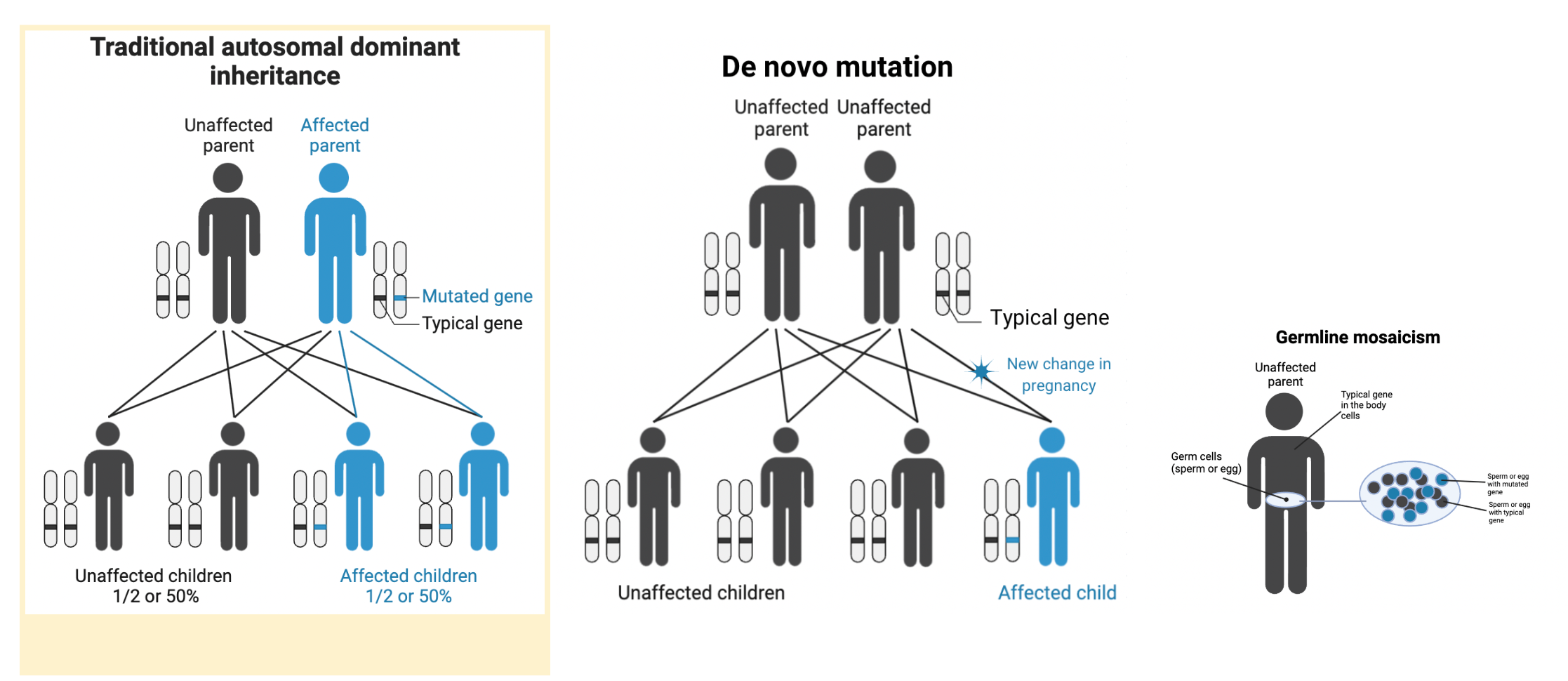
AUTS2 syndrome can arise in two main ways: inherited from a parent or occurring spontaneously (de novo), with a small additional risk from germline mosaicism.
Image sources:
Aicardi Goutieres Syndrome Advocacy Association (AGSAA), Shannon Wieloch, Genetics Corner, URL: https://agsaa.org/genetics-corner, retrieved: 16.03.2026. (Adapted from Biorender)